
How AI Is Redefining SEO — From Traditional to AEO & GEO
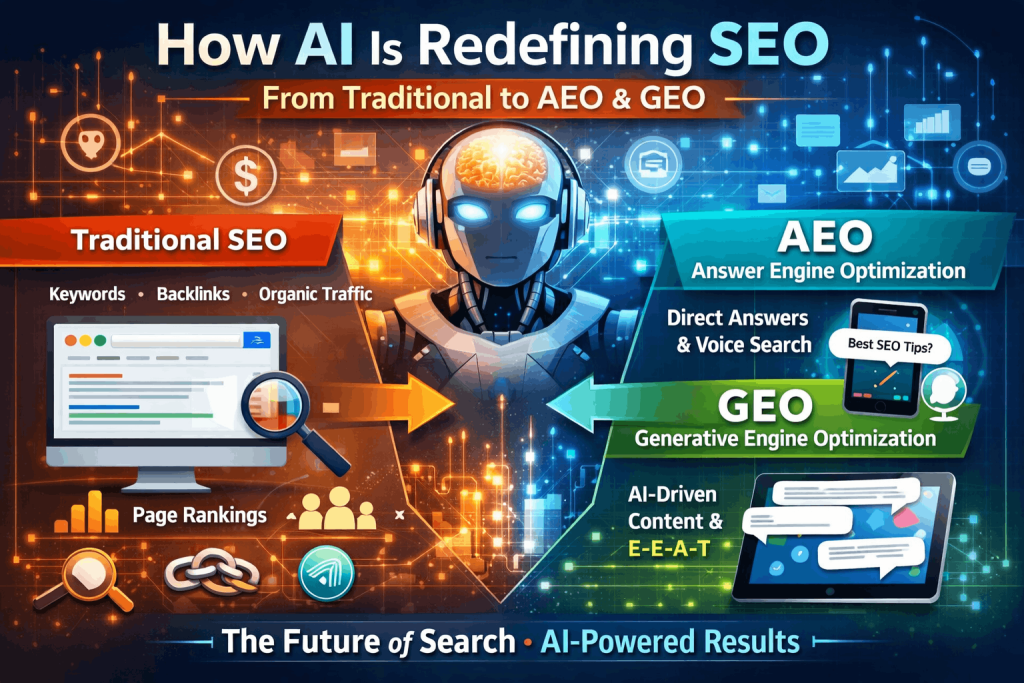
In 2026, the landscape of SEO services is undergoing one of its biggest transformations ever. Traditional Search Engine Optimization (SEO) — centered on keyword rankings, backlinks, and organic traffic — is now being reshaped by Artificial Intelligence (AI) and the rise of AI-powered search systems like ChatGPT, Google Gemini, and Perplexity. This shift has given birth to two new high-impact strategies: Answer Engine Optimization (AEO) and Generative Engine Optimization (GEO) — terms that are trending fast in digital marketing discussions and keyword searches. 📌 From SEO to AEO and GEO — What’s Changing? Traditional SEO has long focused on improving a website’s visibility in search engines by optimizing for high-volume keywords like “SEO services”, “digital marketing strategies”, and “on-page SEO techniques”. These keywords typically have high search volume and remain foundational for content strategy. However, AI is changing how people search for information — and how content must be structured to get noticed. AEO (Answer Engine Optimization) is about crafting content that delivers direct answers to user queries so that it appears in AI-generated featured answers, snippets, and voice assistant responses. Instead of just ranking on a results page, AEO-optimized content is designed to be quoted or summarized directly by AI as the best answer to queries like “what is SEO?” or “best SEO techniques for small businesses.” GEO (Generative Engine Optimization) goes a step further. It optimizes content so that AI systems understand, cite, and trust a brand’s information when generating conversational results. This means structuring content with strong E-E-A-T signals (Experience, Expertise, Authority, Trustworthiness) and semantic depth, so AI can include it in answers to complex research questions. Search behavior statistics now show that a significant portion of searches end without clicks, with users satisfied by AI-generated overviews. 🚀 Why This Matters for SEO Services AI search is accelerating the shift from simply ranking for keywords to being recognized as the trusted source of answers. Modern SEO services must now integrate classic SEO with AEO and GEO strategies: 🔥 High-Search Keywords Still Play a RoleKeywords like “SEO services”, “AI SEO strategies”, “Generative Engine Optimization”, “Answer Engine Optimization”, “Digital Marketing Trends”, “SEO trends 2026”, and “AI search optimization” are trending as marketers search for guidance on adapting to AI-driven landscapes. These remain valuable for organic visibility, but now they’re also used to signal relevance to AI systems. 📊 New Metrics MatterTraditional metrics like rankings and page views are no longer enough. Modern services now track AI visibility, AI citations, and share-of-voice in AI responses — key metrics that determine whether content appears in AI-generated answers instead of traditional SERPs. 🔄 Content Structure Beats Keyword DensityAI systems are smarter than keyword matching — they evaluate context, intent, structure, and authoritativeness. SEO services must focus more on FAQ schema, structured data, clear headings, and conversational language to match user intent and maximize AI citations. 💡 Final Thought The future of SEO is not just about ranking on page one — it’s about appearing inside the answers people trust. As AEO and GEO continue to rise, smart SEO services are those that merge classic optimization with AI-centric strategies, helping brands stay visible and authoritative in an AI-dominated search ecosystem.