
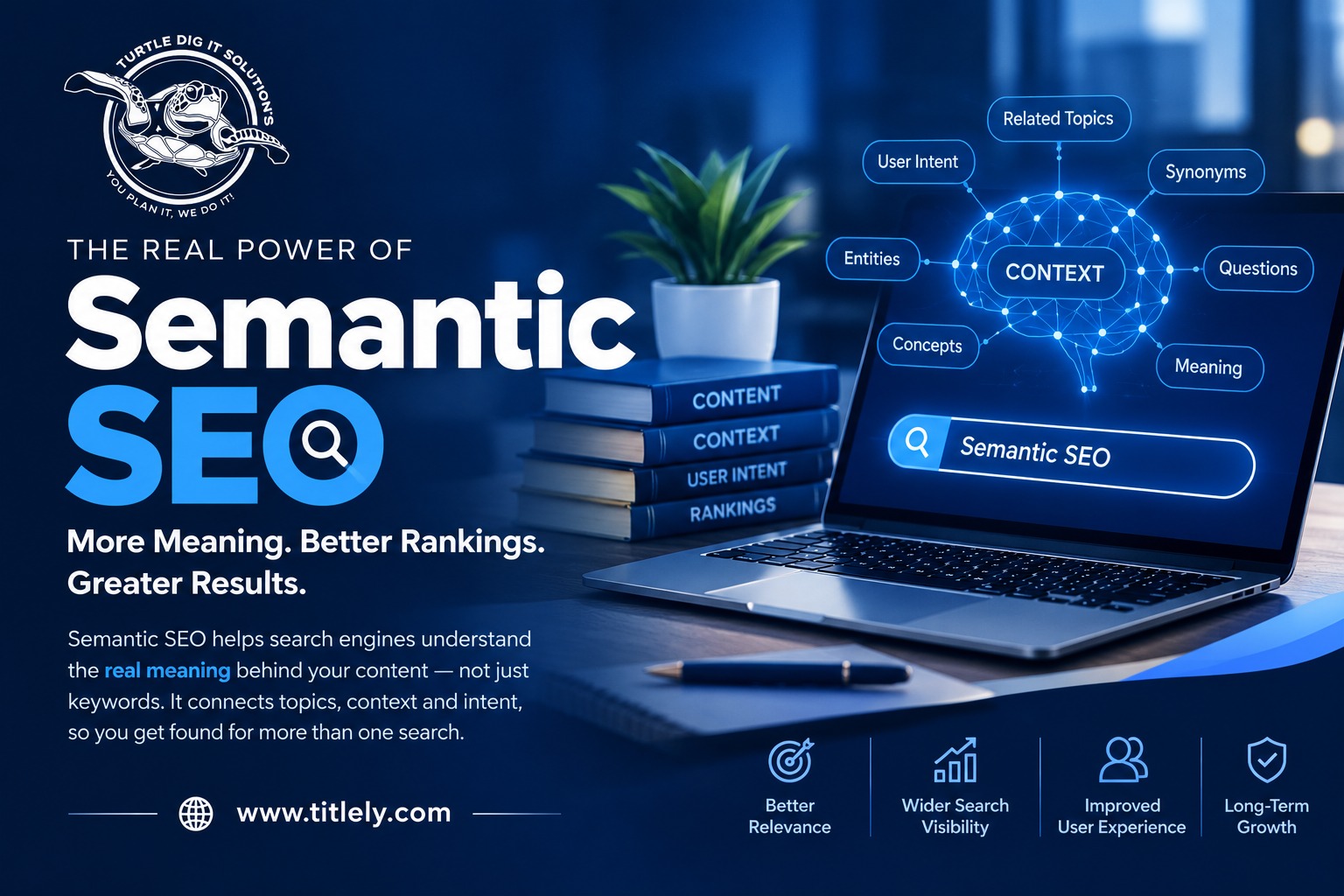
Search is no longer a simple game of repeating a keyword on a webpage. Modern SEO increasingly depends on whether search engines can understand what your content means, what the user wants, and how different concepts are connected.
That is where Semantic SEO becomes important.
Semantic SEO focuses on meaning, context, search intent, entities, related topics, and relationships rather than keyword repetition. Current SEO research also identifies semantic SEO and entity optimization as an important 2026 trend, particularly as AI-powered search becomes more prominent. Ahrefs
What Is Semantic SEO?
Semantic SEO is the process of optimizing content so search engines can understand the complete topic, rather than matching only an exact keyword.
For example, if your main keyword is “SEO services,” a strong semantic page may naturally discuss:
- On-page SEO
- Technical SEO
- Local SEO
- Keyword research
- Search intent
- Content optimization
- Internal linking
- Link building
- SEO audits
- Google Search Console
- Organic traffic
The goal is not to force these terms into the article. The goal is to cover the subject naturally and completely.
Google itself recommends creating helpful, reliable, people-first content that provides substantial and comprehensive information instead of content created mainly to manipulate rankings. Google for Developers
Why Semantic SEO Matters in 2026
The biggest mistake businesses make is treating SEO as a keyword-counting exercise.
For example:
“We provide SEO services. Our SEO services are professional SEO services. Choose our SEO services for the best SEO services.”
This is not semantic optimization. It is keyword stuffing.
A better approach is to explain what the service includes, who it is for, what problems it solves, how it works, what results can reasonably be measured, and how it differs from alternatives.
This creates stronger context and topical depth.
It also matters beyond traditional Google results. Search is increasingly incorporating AI-generated and multimodal experiences. Google added Search Console reporting for multimodal search in September 2026, showing how the search environment is expanding beyond traditional text queries. Google for Developers
4 Semantic SEO Examples
1. SEO Services
Main topic: SEO services
Related concepts: technical SEO, local SEO, content optimization, backlinks, Search Console, keyword research.
2. Digital Marketing
Main topic: digital marketing
Related concepts: SEO, PPC, social media, email marketing, content marketing, conversion optimization.
3. Local SEO
Main topic: local SEO
Related concepts: Google Business Profile, local rankings, reviews, NAP consistency, local keywords and maps.
4. Website Development
Main topic: website development
Related concepts: WordPress, UX, mobile responsiveness, website speed, security, HTML, CSS and JavaScript.
This connected approach helps create a clearer topic ecosystem rather than isolated pages.
How Turtle Dig IT Solutions Uses Semantic SEO
At Turtle Dig IT Solutions, semantic optimization should be treated as part of a broader SEO strategy—not as a replacement for technical SEO, keyword research or quality link building.
A practical semantic SEO workflow includes:
- Identify the main search intent
- Research related topics and questions
- Map important entities and concepts
- Create comprehensive, people-first content
- Build pillar and supporting topic pages
- Connect related pages with meaningful internal links
- Use appropriate structured data where relevant
- Monitor performance through Google Search Console and other SEO tools
Google explains that structured data can help it understand page content and make pages eligible for certain enhanced search appearances. Google for Developers
Simple Example
Suppose Turtle Dig IT Solutions creates a page targeting:
Instead of discussing only SEO packages, the page could naturally cover:
SEO services in Lahore → local SEO → Google Business Profile → technical SEO → on-page SEO → content strategy → keyword research → link building → SEO reporting → search intent.
These relationships give both users and search systems a much clearer understanding of the subject.
FAQs About Semantic SEO
What is Semantic SEO?
Semantic SEO optimizes content around meaning, context, entities, relationships and search intent, rather than relying on exact keyword repetition.
Is Semantic SEO better than traditional SEO?
It is not a replacement for traditional SEO. It extends keyword and technical SEO by making content more comprehensive and contextually relevant.
Does Semantic SEO help rankings?
It can improve relevance and help search engines understand your content, but no SEO technique guarantees rankings. Google emphasizes helpful, original and people-first content. Google for Developers
What are semantic keywords?
Semantic keywords are words and concepts that are closely related to the meaning of the main topic. They are not simply synonyms.
What are entities in SEO?
Entities are identifiable people, organizations, places, products, concepts or other distinct things that search systems can understand and connect with other information.
Does Semantic SEO help AI Search?
Clear topical coverage, consistent entities and well-structured information can make content easier for modern search systems to interpret. However, being semantically optimized does not guarantee inclusion in an AI-generated answer.
Is keyword research still important?
Yes. Semantic SEO does not mean abandoning keywords. Keywords help identify what people search for; semantic optimization helps you build content that addresses the meaning and intent behind those searches.
Final Takeaway
The future of SEO is not “use the keyword more.” It is “understand the topic better.”
Businesses that connect keywords with search intent, entities, related questions, useful content, internal links and strong topical coverage can build a more understandable and useful website.
For Turtle Dig IT Solutions, Semantic SEO should therefore be part of a broader strategy combining technical SEO, content SEO, local SEO, entity optimization, structured data and continuous performance analysis.